



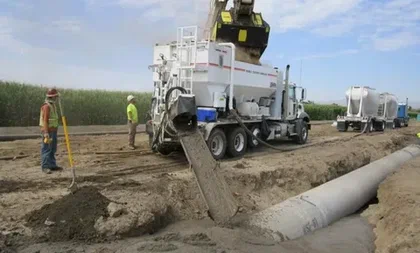
Every contractor knows the feeling. You place a concrete order based on your best estimate, add a safety buffer because running short means delays, and end up with a drum of leftover material you are paying to dispose of. It happens on almost every job that uses traditional ready-mix. On site mixed concrete solves this problem at the source by producing exactly what you need, exactly when you need it, directly on site.
Why Overordering Concrete Is Such a Persistent Problem
Overordering is not carelessness. It is a structural problem built into how traditional ready-mix concrete works.
Traditional drum truck orders are placed in advance based on volume estimates. Because concrete cannot be returned and running short mid-pour causes serious structural and scheduling problems, contractors routinely round up their orders to create a safety margin. This means almost every job produces leftover concrete that must be managed, paid for, and disposed of at additional cost.
The direct financial impact includes:
- Full payment for unused cubic metres of concrete
- Washout and disposal fees charged by the supplier or managed on-site
- Labour costs for handling and clearing surplus material
- Delay costs when underordering trigger the need for a second delivery
The time pressure of a drum truck arrival adds stress to the pour process, as crews work against the clock before the mix begins to set. This pressure often pushes contractors to overorder further, only to create more working time.
What Is Onsite Mixed Concrete and How Does It Work?
On-site mixed concrete, also known as volumetric concrete, is produced by a specialist vehicle that carries raw materials, including cement, aggregate, sand, water, and admixtures, in separate compartments. The materials are batched and mixed fresh at the point of pour, in precise quantities, in real time.
Unlike a drum truck, which arrives with a pre-mixed load that begins setting from the moment it leaves the plant, a volumetric mixer produces concrete continuously and only when the pour is active. The operator controls both the mix design and the output volume directly on site, adjusting either at any point during the job.
Way 1: Mix What You Need, When You Need It
The most direct way onsite mixing eliminates overordering is by removing the need to estimate in advance.
With a volumetric mixer on site, crews start with a calculated target volume based on accurate site measurements. The mixer runs continuously until the pour is complete. If the initial calculation was slightly short, the operator simply continues producing more concrete on the spot. There is no waiting for a second truck, no emergency call to the batching plant, and no pressure to overorder as a precaution.
Therefore, the guesswork that drives traditional overordering disappears entirely. Production matches consumption in real time rather than being fixed to a pre-ordered drum volume placed hours or days before the pour begins.
Way 2: Pay Only for the Exact Volume You Actually Use
Volumetric concrete suppliers operate on a pay-for-what-you-pour pricing model. This means the invoice reflects the precise quantity of concrete produced and placed, not a rounded-up drum load.
The financial benefits are direct and measurable:
- No payment for unused surplus material
- No disposal or washout fees for leftover concrete
- No hidden overhead from safety margins built into every order
- Reduced labour costs associated with managing and clearing excess material
For contractors running multiple jobs per month, the cumulative savings from eliminating even a quarter of a cubic metre of waste per pour add up to a significant reduction in material costs over a working year.
Way 3: Built-In Waste Reduction and Cleaner Sites
Traditional drum truck deliveries generate significant washout waste. Excess concrete remaining in the drum must be discharged and managed on site, creating a disposal challenge that adds both cost and environmental impact to every job.
On-site mixing produces only what is used. There is no surplus in the drum to discharge, no large washout volume to manage, and no contaminated water runoff to control. Sites stay cleaner, disposal costs are eliminated, and the environmental footprint of the pour is reduced considerably.
Additional sustainability benefits include:
- Fewer delivery vehicles required per job, reducing site emissions
- Lower fuel consumption from eliminating unnecessary return trips
- Reduced landfill contribution from surplus concrete disposal
- Smaller carbon footprint per cubic metre of concrete placed
Way 4: Real-Time Adjustments for Design Changes and Site Surprises
Construction sites change. Dimensions shift, footings need to be deeper than planned, and last-minute design changes are a standard part of any project. With a traditional drum truck, these changes mean either running short or ordering an entirely new load.
With a volumetric mixer, the operator adjusts volume and mix design on the fly. A thicker slab, an extra footing, or a change in specification is accommodated without a phone call, without a delay, and without committing to a new minimum order.
This flexibility directly reduces overordering because contractors no longer need to build large safety buffers into their original orders to account for the possibility of changes. The mixer handles variations in real time, which means the order quantity can be based on accurate measurements rather than worst-case assumptions.
Way 5: Better Planning and Fewer Safety Margins in Your Takeoffs
Over time, working with volumetric concrete changes how contractors approach takeoffs and estimating. When overordering is no longer a necessary risk-management strategy, planning becomes more precise.
Contractors who regularly use onsite mixed concrete report that their volume estimates tighten across similar job types because they have accurate data on actual usage rather than rounded-up order quantities. This improvement in estimating precision compounds over time, reducing the urge to add safety margins and standardises material usage across comparable projects.
In addition, more accurate takeoffs improve project profitability by removing the consistent cost of overordering from the material budget on every job.
Beyond Overordering: Other Benefits of Onsite Mixed Concrete
Eliminating overordering is the most immediate commercial benefit, but volumetric mixing delivers additional advantages across quality, speed, and site management:
- Fresher concrete: Material is mixed immediately before placement, maximising workability and strength development
- Continuous pours: The mixer produces concrete without interruption, reducing cold joints and improving structural integrity
- Mix flexibility: Strength, slump, and admixture ratios can be adjusted between pours on the same visit.
- Reduced downtime: No waiting for replacement trucks or managing the timing pressure of a setting drum load
- Lower overall cost: Combining precise volumes, eliminating waste, and reducing labour creates measurable cost savings on every project
Conclusion
Overordering concrete is a cost that most contractors accept as unavoidable. With volumetric mixing, it is not. Producing concrete on demand, paying only for what is placed, and adjusting volume in real time removes the financial and logistical penalties of traditional ready-mix from every job.
Pro-Mix Concrete delivers fresh, precisely batched concrete directly to your site using the volumetric fleet, so you pay for what you pour and nothing more. No surplus, no disposal fees, no second truck. If you are working on a small residential pour or a large commercial project, the team arrives ready to produce the exact mix and volume your job requires.
Contact Pro-Mix Concrete today and stop paying for concrete you never needed in the first place.
